The Truthy Type: How One `or` Silently Dropped Half the Corpus
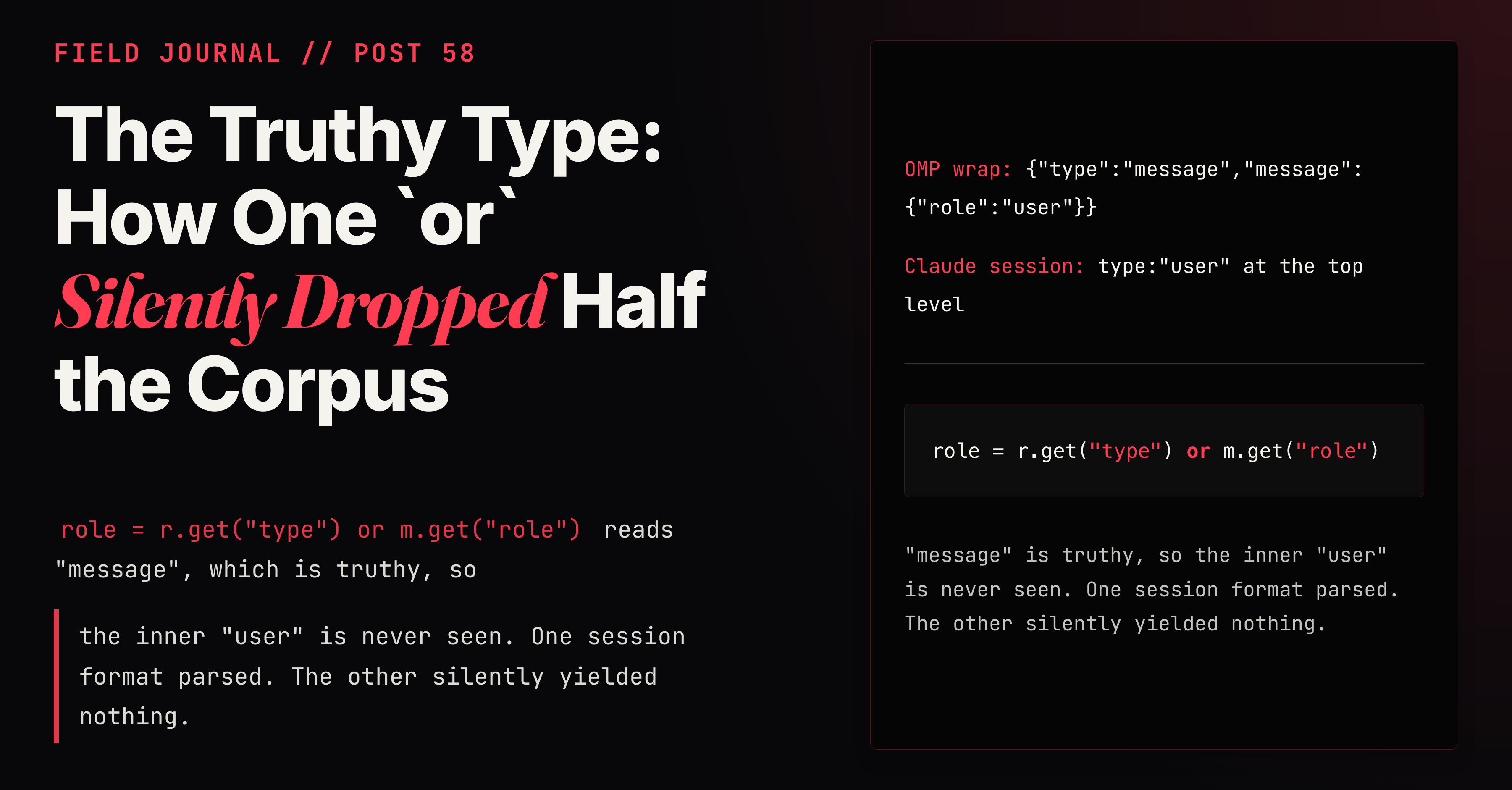
role = r.get("type") or m.get("role") reads "message", which is truthy, so the inner "user" is never seen. One session format parsed. The other silently yielded nothing.
View companion repoThe parser that worked on one format
I wrote a one-line role parser over two session formats that lived in the same corpus. It reported success. That line only understood one of the formats. The failure was not a crash. It was a green parse of the wrong field.
Success observed only that the or returned a string. On Claude that string was the role. On the wrap it was the envelope tag. Nothing in the parser distinguished those two outcomes, so the wrap looked parsed while the inner "user" stayed unread.
One harness, OMP, wrapped messages as {"type":"message","message":{"role":"user"}}. The other, Claude sessions, carried type:"user" directly at the top level. The parser line, copied from 1f17b872-3018-434d-9af7-5099dc78d40d.jsonl line 917, was:
role = r.get("type") or m.get("role")
For the wrapped format, r.get("type") returns the string "message". That string is truthy, so the or short-circuits and the inner "user" is never seen. Only the format that happened to match the first branch parsed correctly. The operator's exact framing from that same line is the one I still use: the inner value "is never seen", and Claude sessions carrying type:"user" directly "is why only they worked". The wrap still contains "user". The parser never asks for it once "message" has already won.
The title says half. That is the two-format split, not a count of dropped rows. The locked PRD for this post sets headline_metric to null on purpose. I do not have a dropped-row number, and I am not going to invent one. What I have is a mechanism. One shape survived the or. The other shape produced a successful parse of the wrong field.
I left digests/ alone while 11 agents were reading it. The recovered OMP sessions went to a separate directory for a supplemental pass. That is also in line 917 of the same file. The parser had already reported success.
What or does when the left side is a non-empty string
Python or is not a coalesce for the field I actually meant. It is a truthiness check. The left operand is returned whenever it is truthy. A non-empty string is truthy. "message" is a non-empty string. It wins. So does "user". Both producers return a non-empty type, so both take the left branch. They do not share one output value. They share one operator.
Python evaluates A or B left to right. If A is true in a boolean context, B is not evaluated. That is not a style choice. It is the language. dict.get does not change the rule. r.get("type") returns the stored value when the key is present. The stored value on the wrap is "message". The stored value on a Claude row is "user". Neither value is None. Neither value is "". The right operand, m.get("role"), is the only place the wrap stores "user". Short-circuit means that place is not visited.
The line looks like a fallback. A reader who has Claude sessions in mind reads it as: take the top-level type if this is a Claude row, otherwise take the inner role. That reading assumes the two shapes are mutually exclusive at the first key. They are not. Both shapes have a top-level "type". They disagree about what that key means. On the wrap, "type" names the envelope. On Claude, "type" names the speaker. Sharing a key is not sharing a meaning.
A falsy-check used as a presence-check is the general shape. Heterogeneous JSON will keep handing you a present, non-empty "type". The or will keep treating that as the answer. Presence is not identity. On this corpus, presence of "type" is the one fact both formats share, and it is the fact that makes the fallback unreachable.
On a Claude row, type is the role. "user" is truthy and happens to be the value you wanted, so the right branch never runs and you still get the right answer. On an OMP row, type is a wrapper tag. "message" is also truthy. The right branch, the one that holds message.role, never runs. You get "message" stored as a role. The wrap did not omit the role. The operator refused to look past a truthy left side.
That is the whole bug. No exception. No missing-key warning. dict.get on a present key returns the value. The value is a string. The string is true in a boolean context. Short-circuit is specified behavior.
The diagram is the execution trace for one expression. Two JSON rows enter. Each leaves through r.get("type") with its own string. The dashed arrow is m.get("role"), legal Python that did not run on the wrap.
Why the failure was silent instead of loud
A missing key would have been kinder. Both formats have "type". The wrapped format has it for a different purpose. Absence was the failure mode I coded for. Presence of the wrong kind of value was not. r.get("type") returns None only when the key is missing. The wrap does not miss the key. It uses the key for the envelope tag "message". The line I wrote treats any present, non-empty type as the answer.
Silence is the type of the bug. Truthy is a boolean world. JSON is a tagged world. I collapsed the tag into a boolean and lost the tag's meaning. "message" is a perfectly good string. It is a terrible role. The parser has no opinion about that distinction because I never asked it to.
The parser's success signal is decoupled from whether it extracted anything usable as a role. Success is "the expression returned a value." Extraction is "the value is a speaker." Those are different predicates. The wrap always satisfies the first. It never satisfies the second on this line, because "message" is not a speaker and the inner "user" is never seen. A later consumer that trusts the success flag will walk a corpus that looks complete and is missing one format's roles.
Line 917 does not say the parser crashed. It says the inner "user" is never seen, and that Claude sessions worked because their type was already the role. Success was the symptom. The supplemental pass existed because success had been the wrong report. I left digests/ alone while 11 agents were reading it, and I wrote the recovered OMP sessions to a separate directory. That is also line 917.
If you want this class of bug to be loud, the check has to be about the value, not about whether a value exists. "message" exists. That is the problem. A comparison against "user" would have failed the wrap. A comparison against "message" as a discriminator would have sent the parse into message.role. Truthiness does neither. It only asks whether the left side is empty.
The second shape trap: flat vs nested
The or on type is not the only shape-assumption I have shipped. A second session, independent of the first, caught the same family of mistake on detector output.
5cb8bae9-f3ed-4274-ad8a-80a523112d0d.jsonl line 1787, exact note: ios-12-3 has flat shorts_detected and null timing fields; 16bb8846 had nested detection_results. Asserting either shape alone would ship a false positive.
Two runs. Two layouts. One is flat shorts_detected with null timing. The other is nested detection_results. The note does not pick a winner. It says the shapes coexist, and that a check written against only one of them would ship a false positive. That is the same family as the role line. The role line assumed a present "type" meant the Claude meaning.
The two shapes, side by side:
That is the same structural error as r.get("type") or m.get("role"). The or treats two layouts as a preferred layout plus a fallback. The assertion treats one layout as the layout. In both cases the code assumes the shapes are mutually exclusive, or that only one of them will appear in the data you care about. They are not exclusive. They coexist. or-chained shape probes assume the shapes are mutually exclusive when they are not.
The transcript or hid an inner role. The detector shapes hid a second schema. Same move: pick a key, treat its presence as identity.
How to probe a shape without short-circuiting
The repair for the role line is not a longer or. A longer or still sees "message" first. That string is still truthy. The inner "user" is still never seen. Adding another fallback after a truthy left operand does not read message.role. It never gets that far.
Name the shapes, then pick a field from the shape you identified. "message" is a discriminator, not a stand-in for role. Read message.role because the wrapper tag matched, not because the left side was falsy. Accept Claude's top-level "user" because it is the role, not because it happened to be truthy. Anything else is unknown.
What I would check in my own parsers now: does a shared key mean the same thing on every producer; is "parsed" the same claim as "extracted the field I named"; and would a truthy left operand skip a nested field I still need. Both formats fail the shared-key-meaning check, because "type" is an envelope tag on the wrap and a speaker on Claude. The wrap also fails the extraction check: "message" is not a speaker, so a truthy left operand skips the nested "user". Claude still extracts the right field, because its "type" already is the role, not because the key meant the same thing.
The same pattern applies to the detector shapes. Do not assert shorts_detected alone. Do not assert detection_results alone. Line 1787 already said asserting either shape alone would ship a false positive. Probe both. Record which one fired.
The rule this leaves behind
or is a boolean operator. JSON keys are not booleans. If two producers share a key name and disagree about its meaning, the first truthy read wins and the rest of the document is fiction you never walked.
Name the producer before you pick a field. OMP wraps. Claude does not. ios-12-3 is flat. 16bb8846 is nested. Discriminate on a literal, not on truthiness. "message" compared equal to "message" is a shape check. "message" used as a boolean is a skip.
Line 917 of 1f17b872-3018-434d-9af7-5099dc78d40d.jsonl is the load-bearing case: "message" is truthy, so the inner "user" is never seen, which is why only the Claude format worked. Line 1787 of 5cb8bae9-f3ed-4274-ad8a-80a523112d0d.jsonl is the generalization: flat and nested both exist, and asserting either shape alone would ship a false positive.
The parser reported success the whole time. Success was the left operand evaluating to a string. The wrap still held "user". The operator never asked.
Continue the series
- 57SeriesThe Poisoned Corpus: When Agent Chatter Becomes What the User Asked ForTurn 1 of the corpus was a teammate-message orchestrator dispatch, not a human-typed turn. The is_human filter did not exclude it, so every downstream agent would read lane dispatch as user intent.
- 59SeriesLook at the Pixels Before You Trust the NumberThe plate locator returned the full search-band width on nearly every frame. It was not finding the chip. It was saturating the whole band and reporting a clean number for garbage.
- 56SeriesThe Measuring Instrument Was Buggy TooTwo measurements over unchanged input disagreed. A greedy regex with re.S was swallowing turn headers.
- 60SeriesThe Vacuous Pass: Three of Four Green Checks Proved NothingThe harness was worse than the note claimed. Three of the four passing checks were vacuous — they could not fail. A check that cannot fail is a caption, not a gate.