Building Claude Code Plugins That Actually Work
Hooks, skills, and the enforcement layer that turns agent suggestions into hard stops across 23,479 sessions
View companion repoI put “NEVER create test files” in CLAUDE.md. The agents created test files anyway.
Bold formatting, triple emphasis, all-caps warnings. The violation rate dropped but never hit zero. Across 23,479 sessions, the pattern was obvious: text-based instructions are suggestions. Agents deprioritize them when context gets long, when the task gets hairy, when the implementation chain goes deep. It’s not defiance — the agent is making trade-offs in a limited context window, and “do not create test files” loses to “I need to verify this function works.”
Then I wrote a 72-line JavaScript hook that blocks Write calls to any file matching test patterns. Violation rate: zero. The Write tool call hits the hook, the hook returns exit code 2, and the agent sees a message explaining why the action was rejected. Not a suggestion. A hard stop.
“That’s the difference between a skill that suggests and a plugin that enforces.”
The Gap Between Instructions and Enforcement
Claude Code’s plugin system has four extension points: hooks that fire on tool events, skills that provide domain workflows, agents that define specialist roles, and MCP servers that add tool capabilities. Most people use CLAUDE.md and maybe a few skills. Almost nobody builds hooks. That’s a mistake.
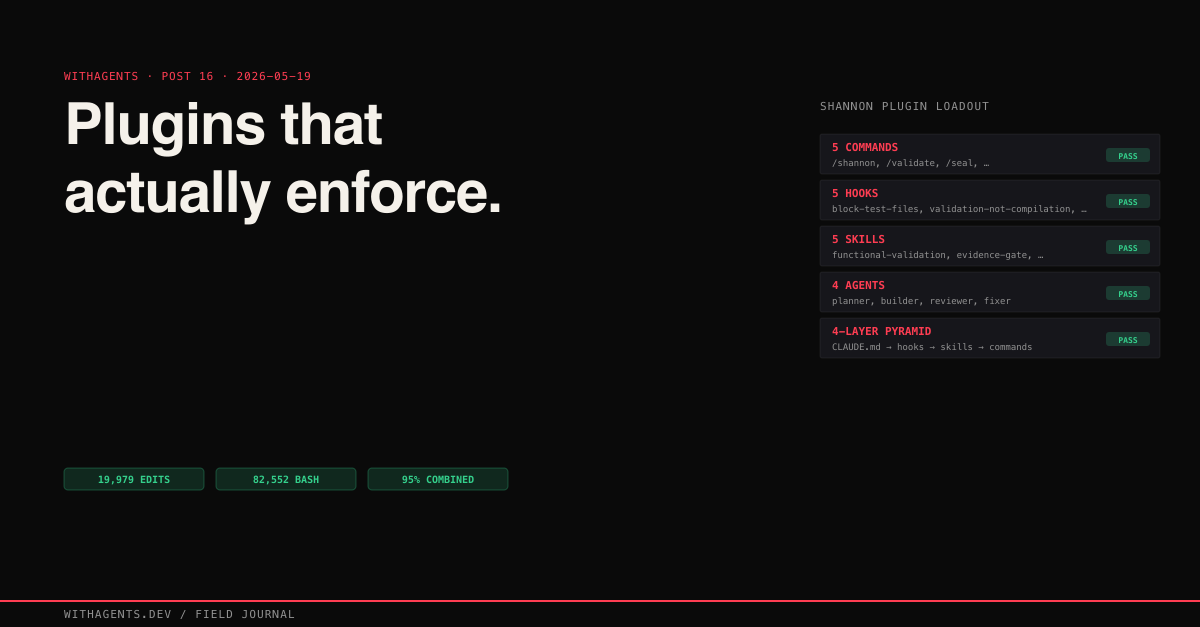
Across 23,479 sessions, the Skill tool fired 1,370 times. The tool leaderboard: Read fired 87,152 times, Bash fired 82,552 times, Edit fired 19,979 times. For every skill invocation, there were 63 Read calls and 60 Bash calls happening without any skill guidance.
Skills are opt-in. Hooks are mandatory. Every one of those 19,979 Edit calls passed through my PreToolUse hooks. Every one of those 82,552 Bash calls triggered my PostToolUse hooks. The agent doesn’t choose to comply. The enforcement layer checks automatically, on every tool call.
One Hook, End to End
Here’s what a hook actually does. This is validation-not-compilation.js from the shannon-framework. It fires after every Bash command, watches for build success, and injects a reminder that “it compiled” is not “it works.”
The problem it solves: agents conflate build success with feature completion. A clean build means the code is syntactically correct and type-safe. It says nothing about whether the feature does what you asked. Without a hook, the agent runs npm run build, sees “compiled successfully,” and marks the task done. The feature is broken. Nobody checked.
The hook source:
Shannon v6 factored the hook through a shared runHook() wrapper in lib/hook-runner.js; the regex pair (build commands, success indicators) is now a single line each, and the stderr reminder routes the agent to /shannon:validate instead of repeating an inline checklist.
Integration via settings.json:
Drop the file in .claude/hooks/, add the entry to .claude/settings.json, and the hook fires on every Bash call for every session. No registration, no manifest parsing.
What it catches in practice: during a Next.js feature build, an agent ran pnpm build, got “Compiled successfully,” and started drafting a completion message. The hook fired. The agent spun up the dev server and found a server action returning 500 — an environment variable wasn’t set in the test environment. Build: green. Feature: broken. The hook caught it 20 minutes before it would’ve surfaced in production.
Across 82,552 Bash calls in 23,479 sessions, the hook fired every time a build succeeded. Every time.
The Hook Lifecycle
Three intercept points: before the tool runs, after it finishes, and once per user message. That’s the full lifecycle.
Three event types, three possible responses. That’s the entire hook API:
- 01PreToolUse fires before the tool executes. It can block (write to stderr, exit code 2), warn (inject context and allow), or silently allow (exit 0 with no output).
- 02PostToolUse fires after execution completes. It can inject reminders based on output by writing to stderr and exiting with code 2. It can’t block the action already taken, but it shapes what the agent does next.
- 03UserPromptSubmit fires on every user message, before the agent starts reasoning. It can inject workflow requirements or force skill evaluation.
A detail that bit me: a hook that crashes is a silent allow — the tool call proceeds as if no hook existed. A broken hook should never break the agent. But wrap every hook in try/catch, because a silently failing hook is worse than a missing one. At least a missing hook is obvious.
The 4-Layer Enforcement Pyramid
A single enforcement mechanism isn’t enough. CLAUDE.md instructions get forgotten. Hooks are too rigid for nuanced decisions. Skills require invocation. Commands require user action. The Shannon Framework — named after Claude Shannon, who proved reliable communication requires redundant encoding — layers all four.
Each layer catches what the previous one misses:
- 01CLAUDE.md tells the agent what to do. Agents forget. Compliance: ~60%.
- 02Hooks enforce rules automatically. Can’t handle nuanced workflows. Compliance on targeted behaviors: near 100%.
- 03Skills provide structured workflows with context the agent lacks. They require invocation, and agents skip them under pressure. The skill-activation-check.js hook closes this gap.
- 04Commands give users direct control — the final safety net.
Combined 4-layer compliance: 95%+. The remaining 5% is why you still review the output.
The Other Four Hooks
The Shannon Framework ships five hooks total. validation-not-compilation.js is covered above. Here are the other four.
block-fab-files.js — The Hard Stop. PreToolUse on Write, Edit, and MultiEdit. Checks the file path against 12 fabricated-artifact patterns (test files, mocks, stubs, fakes, fixtures). Scoped to src/, lib/, app/ only, with explicit exemptions for scripts/, tools/, evidence trees, and skill/agent markdown. Violation rate went from non-zero to zero.
Twelve patterns cover test files, mocks, stubs, fakes, and fixtures across language conventions. Shannon v6 renamed the hook from block-test-files.js to block-fab-files.js (fabricated artifacts) and added scope + exemption tables so the matcher no longer false-positives on legitimate scripts/, tools/, or skill markdown. Every block message includes the path, the matched pattern, and the IRON RULE that explains why.
read-before-edit.js — The Context Guardian. PreToolUse on Edit and MultiEdit. Tracks which files have been Read in the current session. When an Edit targets a file not in that Set, the hook warns. It doesn’t block — sometimes you need a quick edit. But the warning is specific enough to change behavior.
Before this hook, the Read-to-Edit ratio was close to 2:1. After: 4.4:1. The hook didn’t just warn — it changed how agents sequence their work.
evidence-gate-reminder.js — The Completion Checkpoint. PostToolUse on TaskUpdate. Fires when a subagent marks a task complete. Injects a five-question evidence checklist before the orchestrating agent can rubber-stamp the claim.
The failure mode: subagents mark tasks complete after a clean build, orchestrating agent accepts without examining evidence, task is “done” but feature is broken. This hook makes that impossible to do silently.
skill-activation-check.js — The Skill Enforcer. UserPromptSubmit. Watches for implementation-related prompts and reminds the agent to scan the skill list. Bridges Layer 2 (automatic hooks) and Layer 3 (invocable skills). A hook can’t invoke a skill on its own — but it can remind the agent that skills exist at the moment the agent is about to start implementing without them.
The stdin/stdout Contract
Every hook follows the same interface regardless of event type. Claude Code spawns the hook script as a child process, writes JSON to its stdin, and reads from its stderr.
PreToolUse hooks receive:
PostToolUse hooks receive the same, plus output:
UserPromptSubmit hooks receive:
Three possible responses:
That’s the entire API. No registration, no manifest parsing, no framework overhead.
What Breaks and How to Fix It
I’ve debugged enough hooks to compile a failure catalog.
Matcher mistakes. Write matches the Write tool. It doesn’t match Edit or MultiEdit. If you need all three, use Write|Edit|MultiEdit. If your hook isn’t firing, check the matcher first.
Silent crashes. A hook that throws an unhandled exception produces no output — silent allow. Always wrap everything in try/catch with a process.exit(0) fallback. A crashing hook is worse than a missing one because you think you’re protected and you’re not.
Performance traps. Hook scripts have to be fast. Synchronous. Under 100ms. No network calls. I had a hook that validated imports against a remote package registry — added 2 seconds to every Edit call. Moving validation to a PostToolUse hook that batched checks eliminated the latency.
The hook that cried wolf. Too many warnings train the agent to ignore them all. Each of my five hooks targets a specific, dangerous behavior with a clear trigger. A hook that warns on every file edit becomes noise. validation-not-compilation.js fires only after build commands that succeed, not after every Bash call.
State management gotchas. The read-before-edit.js hook tracks state in a module-level Set. Works because Claude Code loads hooks once per session and keeps them in memory. Restart the session, the Set is empty. Don’t rely on hook state across sessions. Use the filesystem or an MCP server.
Skills: The Structured Workflow Layer
Hooks enforce boundaries. Skills provide workflows. The functional-validation skill in the Shannon Framework is a SKILL.md file, a markdown document with trigger patterns, context, and execution steps:
When the agent invokes this skill, it loads these instructions into context. The five execution steps become the agent’s workflow. The checklist makes sure the agent doesn’t skip the evidence phase.
Skills and hooks reinforce each other. The skill tells the agent how to validate. The block-fab-files.js hook prevents shortcuts. The validation-not-compilation.js hook catches build success declared as validation. The evidence-gate-reminder.js hook catches tasks marked complete without evidence. Together, they create an enforcement surface that’s hard to circumvent.
Hooks vs. MCP Servers vs. CLAUDE.md
The decision framework:
Use CLAUDE.md for general guidance that doesn’t need enforcement. Style preferences, architectural conventions, project context. If 60-70% compliance is enough, CLAUDE.md works.
Use a hook when you need to intercept an existing tool call. Block certain Writes, inject warnings after Bash, remind on Edit. Hooks modify existing behavior automatically.
Use an MCP server when you need to give the agent a capability it doesn’t have. Query a database, search an AST, interact with an LSP server, manage persistent state. MCP servers add new tools.
Use a skill for structured, multi-step workflows that carry domain context. Validation protocols, review checklists, deployment procedures. Skills are invocable — pair them with a UserPromptSubmit hook to make sure the agent loads them.
The Shannon Insight
Claude Shannon proved you can transmit information reliably over a noisy channel by adding redundant encoding. Same principle applies here. A single instruction in CLAUDE.md is a signal in a noisy channel. Long context, competing priorities, complex task chains. By the time the agent is deep in an implementation, that instruction is noise.
Redundant encoding means saying the same thing four ways, at four enforcement points:
- 01The CLAUDE.md rule says “no test files.”
- 02The block-fab-files.js hook blocks test file creation at the tool boundary.
- 03The functional-validation skill provides an alternative workflow.
- 04The /autopilot command orchestrates the entire flow including validation.
CLAUDE.md guides the well-behaved agent. The hook stops the forgetful agent. The skill redirects the agent that wants to verify but doesn’t know how. The command handles the case where the user needs to drive.
I thought hooks alone would be enough when I first built this. I was wrong. An agent blocked from creating test files doesn’t know what to do instead. It sits there, confused. The skill layer exists because blocking bad behavior without providing an alternative is only half the solution.
Before hooks, every agent ignored at least two rules per session. After hooks, zero violations on blocked behaviors. The 19,979 Edit calls all passed through read-before-edit.js. The 82,552 Bash calls all passed through validation-not-compilation.js. Every single call, without me watching, without the agent choosing to comply.
“That’s what a plugin system is for. Not adding features. Adding discipline.”
Continue the series
- 15CoordinationThe Anatomy of a Claude Code SkillHow SKILL.md files turn repeatable workflows into invocable prompt programs — and the factory that generates them
- 17CoordinationThe Claude Code Builder (CCB) Evolution: From Bash Script to Autonomous BuilderFour generations of Claude Code builders — each one a lesson that cost real money and real patience to learn
- 18CoordinationSDK vs CLI: The Decision Framework That Took 23,479 Sessions to LearnWhen to call the API directly, when to use Claude Code CLI, and when you need both — a practical decision framework from across the series
- 19CoordinationAnneal: Three Planning Variants for Agentic DevelopmentLinear, tournament, and convergence pipelines that turn rough ideas into executable plans