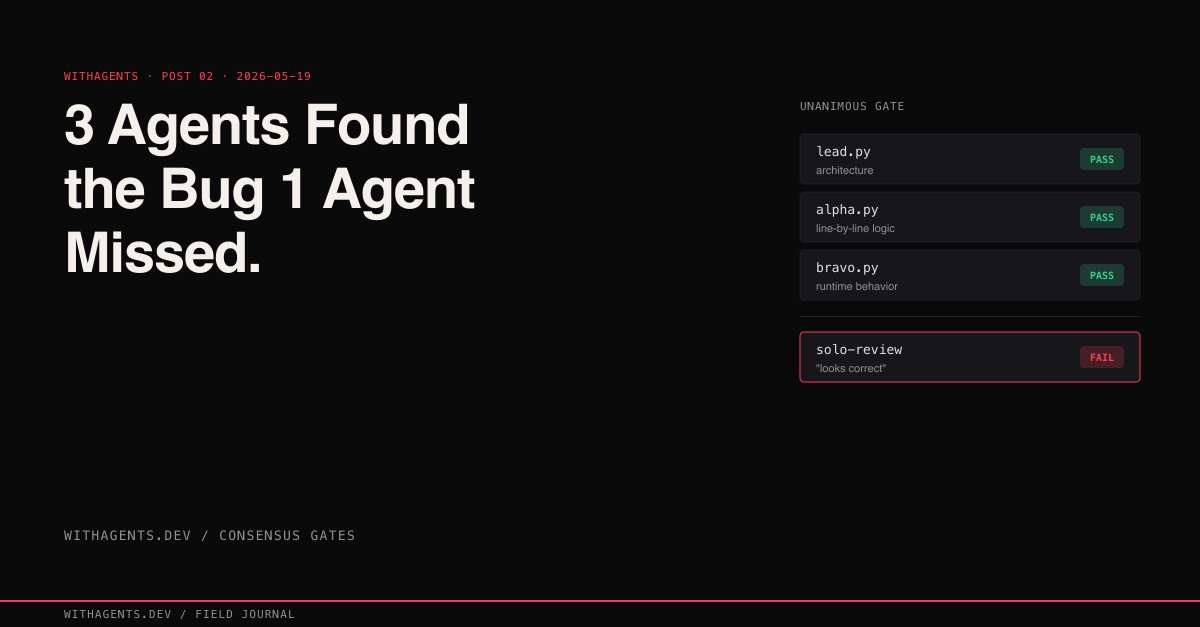
3 Agents Found the Bug 1 Agent Missed
Why multi-agent consensus catches what solo review cannot
View companion repoA single AI agent reviewed my streaming code and said "looks correct." Three agents found a P2 bug on line 926 that’d been hiding for three days.
That gap between one confident wrong answer and three analyses converging on the real problem? It’s why every code change in my system now goes through a unanimous consensus gate before it ships.
I’ve watched solo agents approve broken code across 929 agent spawns. Not because the agents were bad. Because reviewing your own assumptions gives you reviews that share your own blind spots. The fix isn’t a better agent. It’s three agents that disagree with each other until they converge.
The Bug on Line 926
Line 926 of my iOS app’s streaming message handler:
Should’ve been:
One character. += instead of =. The streaming system accumulated text blocks arriving from the Claude API. Each block contained the full message up to that point, not a delta. So += appended the full accumulated text to what was already there. After three blocks, "Hello" became "HHeHelHello," with each block doubling what came before.
The second root cause was subtler. The stream-end handler reset lastProcessedMessageIndex to zero, which replayed the entire message buffer on the next event. Combined with +=, messages grew exponentially. A five-sentence response turned into an unreadable wall of duplicated text, growing with each chunk.
“Three days. This sat in the codebase for three days.”
I ran a solo agent review on the streaming module. It read top to bottom, checked types, verified function signatures matched the protocol. No issues found. Code was syntactically valid. Types correct. Protocol conformance complete. Everything a single-pass review checks came back clean.
Then I ran three agents with different review mandates. Alpha caught the +=. The API sends full messages, not deltas, so appending makes no sense. Bravo came at it from a completely different angle: what happens when one stream ends and another begins? That index reset replays the entire buffer. And Lead pointed out the module’s own doc comments explicitly say text blocks are cumulative. Three reasoning paths, same conclusion.
Why One Agent Isn’t Enough
Ever had a code review where the reviewer just… agreed with everything? That’s what happens when the same entity writes and reviews code. Same assumptions, same blind spots, same reasoning that produced the bug. I’ve watched this play out across 929 agent spawns. It isn’t theoretical.
The Frankenstein merge made it concrete. Two agents worked on the same backend service. Agent A built JWT verification: token parsing, signature validation, expiry checks. Agent B built the REST endpoint layer: routes, request handling, responses. Neither knew the other existed.
The merge produced valid code. TypeScript compiled clean. Linter passed. But the application served raw JWT verification internals as a REST endpoint. Token payloads. Signature validation state. Expiry calculations. All exposed to unauthenticated callers.
Think about that for a second. A security vulnerability that passed every static check because each agent’s contribution was individually correct. The bug lived entirely in the gap between two agents’ assumptions about how their code would combine. No single-agent review would’ve caught it, because each agent would just confirm its own work looked fine.
Three Roles, Not Three Copies
The system doesn’t run three identical agents. Same prompt three times just gives you three copies of the same blind spot. Each agent gets a different review mandate targeting different failure domains.
Lead handles architecture and consistency. Does this change fit existing patterns? Introduce duplicate abstractions? Lead wouldn’t have found the += bug. That’s not an architecture issue. But Lead caught the Frankenstein merge immediately because the merged code blew right through the service’s architectural boundaries.
Alpha does line-by-line logic. Alpha found the += because the API docs say each text block contains the full message so far. If message.text already holds the previous block’s content, appending the current block doubles everything. Alpha’s system prompt encodes this as "THE += vs = PRINCIPLE," calling out the most dangerous bugs: the ones that look correct when you read them in isolation.
Bravo thinks about what happens at runtime. Will this work deployed? Race conditions? Realistic failure modes? Bravo found the index reset by reasoning through the streaming lifecycle: stream ends, next stream begins, index goes to zero, handler replays every message from the buffer. Combined with any accumulation bug, that replay compounds the damage. Bravo’s prompt says it plainly: "Alpha reads code. You RUN things."
Here’s the actual gate output from the streaming audit:
Lead found the scope: both SDK and CLI code paths share the flaw. Alpha found the line and the semantic error. Bravo found the user-visible symptom. None would’ve been enough alone. Together, complete picture.
Below — pick a scenario. Watch the three reviewers reach (or not reach) unanimity in real time:
message.text += textBlock.text
The Consensus Gate Framework
The gate itself is the simplest part. A ThreadPoolExecutor runs all three agents in parallel, then checks for unanimity:
Each agent runs as a separate claude --print subprocess with its role-specific system prompt. No shared state during evaluation. Unanimous voting. Not majority. Any agent raises a concern, the gate blocks. This is deliberately conservative, and that’s the whole point. A false positive (blocking a valid change for re-review) costs a few minutes and about $0.15. A false negative (shipping the += bug) costs three days of broken messages and trust you can’t buy back.
The re-validation step is critical and easy to screw up. When a gate fails and you fix the issue, ALL THREE agents re-validate, not just the one that originally failed. This catches fixes that solve one problem but introduce a new one that only a different agent’s perspective would spot. Three fix cycles max. Can’t reach unanimity after three rounds? Escalates to a human. In practice, most gates converge on the first or second cycle.
The Pipeline: Four Phases, Four Gates
The framework isn’t just one gate. It runs four phases, each with its own checkpoint.
Explore maps the codebase. All three agents independently trace the architecture and note concerns. The gate makes sure everyone has a complete picture before the deep audit.
Audit is the deep review. This is where the += got caught. Each agent applies its specialized lens.
Fix verifies fixes actually address the findings. All three agents check independently. Catches the "fix that creates a new bug" pattern.
Verify is end-to-end. Does the system actually work? Bravo’s biggest moment.
Lead runs on Opus for deeper architectural reasoning. Alpha and Bravo run on Sonnet, fast enough for line-level analysis and system-level checks. All three run in parallel, so wall-clock time equals the slowest agent (typically 15-30 seconds per gate). Four-gate pipeline: roughly $0.60 total.
Institutional Knowledge: Prompts That Learn
Here’s the part I didn’t expect. Each agent’s system prompt accumulates real bug patterns over time. After 200 gates, Alpha has 47 specific patterns to check. Bravo has 31. Lead has 22. Every bug the system catches becomes a permanent instruction:
When a bug gets caught, I extract the detection heuristic (what made it catchable) and encode it as six lines in the relevant agent’s prompt. Alpha’s 47 patterns cover streaming semantics, off-by-one errors in pagination, optional chaining pitfalls, async race conditions. Each one’s a scar from a real incident.
Maintenance cost? Basically zero. They’re version-controlled text files. When something slips through, I add a pattern. After 200 gates, the system catches things gate 1 would’ve missed. The prompts compound.
The 75-TaskCreate iOS Audit
How far does this scale? Session f9d4b6e2 ran a 6-phase, 10-gate validation of dual-mode iOS streaming (SDK and CLI modes). Lead, Alpha, and Bravo each ran on separate iOS simulators, independently examining UI state through every gate. 75 individual TaskCreate operations for a single audit.
Two findings despite a PASS. Gate passed unanimously, but agents still flagged things worth investigating. That’s the difference between "approve with notes" and "reject."
The gate blocked on Bravo during voting. Lead and Alpha had already voted PASS, but the gate couldn’t advance until all three were in. Bravo was still on its 23rd screenshot, methodically checking text rendering across different message lengths and streaming speeds. The gate waited. That’s unanimous voting in practice: the fastest agents wait for the most thorough one.
File Ownership: Preventing the Frankenstein Merge
Multi-agent teams have a coordination problem consensus alone doesn’t solve: who owns which files? The Frankenstein merge happened because two agents edited adjacent code without knowing about each other. File ownership via glob patterns prevents it:
Before an agent writes to a file, the orchestrator checks the ownership map. File belongs to another agent? Blocked. Two agents literally can’t edit the same file.
Here’s the thing. Humans notice when they’re about to touch someone else’s code. The directory’s unfamiliar, the patterns look different, the imports are foreign. Agents don’t have that spatial awareness. They’ll edit whatever the prompt tells them to, regardless of who else is working in the same area. Programmatic enforcement replaces the social awareness humans take for granted.
When two agents genuinely need the same file, the lead makes the change and distributes the result. Single writer, everyone else reads.
Scaling Consensus to Planning
Same three-perspective pattern works for planning too. Three agents: Planner, Architect, and Critic.
Planner decomposes work into tasks. Architect evaluates technical soundness. The Critic's job? Break things. Challenge every assumption, find the failure mode the other two are too close to see. The Critic isn't trying to help. It's trying to find what goes wrong.
The war story that proved this: a Supabase auth migration. Planner decomposed it into 14 tasks. Clean decomposition, reasonable ordering, 1-2 hours each. Architect vetoed it.
Why? Supabase Row Level Security policies reference auth.uid(), which returns Supabase's internal user ID, not a custom JWT's subject claim. Seven of the 14 tasks assumed RLS compatibility. They would've compiled. Would've passed type checks. Would've failed silently at runtime, letting any authenticated user read any other user's data.
The Critic piled on: no rollback strategy. If task 9 fails, tasks 1-8 already modified the auth schema. Only recovery is a full database restore.
Three rounds of iteration. Planner revised. Architect re-evaluated. Critic challenged the revision. Final plan: 11 tasks instead of 14, an RLS compatibility layer, and rollback checkpoints at tasks 4, 7, and 10, each able to revert without nuking the whole database.
“Three rounds, under $2. Cost of shipping a silent auth bypass where every authenticated user can read everyone else's data: I don't want to think about it.”
When Not to Use Consensus
It costs money. Roughly $0.15 per gate, $0.60 for a four-phase pipeline. So when is it worth it?
- Changes touching shared state, auth, data persistence, or streaming
- Multi-agent merges where code from different agents gets combined
- Cross-module or interface changes
- Anything involving security, user data, or payments
- String constant updates, typo fixes, adding a log line
- Single-file changes with zero behavioral impact
- One-line changes with no downstream effects
- For genuinely novel work where no agent has relevant experience, consensus can produce false confidence.
- If three agents cannot agree in five rounds, the disagreement is real and needs a human.
The += bug cost three days of debugging. The Frankenstein merge could’ve exposed tokens to the internet. $0.15 to prevent either isn’t even a conversation.
The Asymmetry That Makes It All Work
False positive: gate blocks a valid change. Costs five minutes and $0.15 for re-review. False negative: gate ships the += bug. Costs three days of corrupted messages and user trust you can’t buy back. Every design choice here leans toward the first failure mode. Unanimous voting. Distinct mandates. Institutional knowledge. File ownership. Full re-validation after fixes. All weighted the same direction.
“False positive rate runs around 8%. The bugs the other 92% catches would’ve shipped.”
The += would’ve corrupted every message in the iOS app. The Frankenstein merge would’ve exposed JWT internals to unauthenticated callers. The Supabase RLS gap would’ve been a data breach.
What’s next: how functional validation catches failures that even three agents reviewing source code can’t see. Because reading code, no matter how many perspectives you throw at it, isn’t the same as running it.
Continue the series
- 01Foundation23,479 Sessions: What Works in Agentic DevWhat 11.6GB of session data across 27 projects reveals about building production software with AI agents
- 03FoundationI Banned Unit Tests and Shipped FasterWhy functional validation replaced testing when AI writes the code
- 04FoundationThe Five-Layer Streaming BridgeToken-by-token Claude streaming on iOS — after four failed architectures
- 05ValidationiOS Patterns from 4,597 Agent SessionsWhat 4,597 sessions taught me about SwiftUI, state, and survival — five patterns from three iOS apps that earned their keep or crashed.