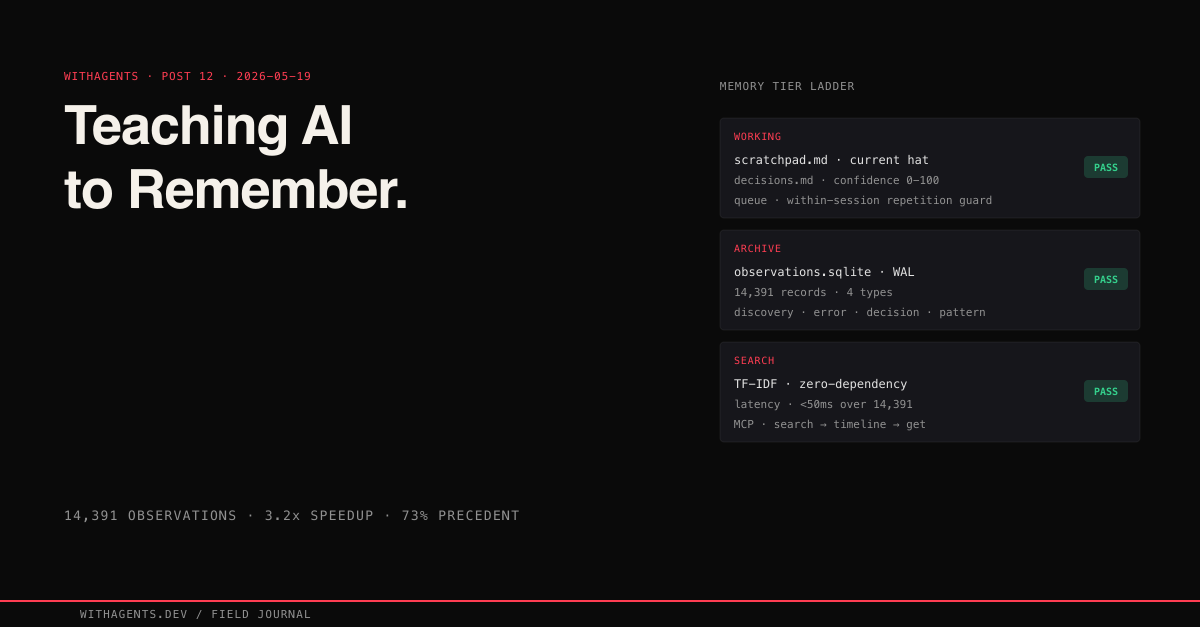
Teaching AI to Remember: Cross-Session Memory
A SQLite observation store and MCP memory server that turns 23,479 sessions of amnesia into searchable institutional knowledge
View companion repoSession 4,200. I’m watching a Claude Code agent rewrite a database migration that I know, I know, session 3,800 already solved. Same table. Same foreign key constraint. Same solution it’s about to spend 20 minutes rediscovering. And I can’t do anything except sit there, because the agent has no idea session 3,800 ever happened.
Every Session Is Session 1
Across 23,479 sessions, the agent re-performs the same mistakes with the same confidence, over and over.
The wasted tokens aren’t what bothered me most. It’s the wasted attention. I’d watch an agent spend 20 minutes rediscovering that @StateObject initializers can’t reference other state properties in SwiftUI — something session 3,800 had already figured out. Each time: same confidence, same wrong approaches, same eventual solution. No hedging. No “I think I’ve seen this before.” Just a performance of discovery.
Session 12,100: an agent tries the same three failed approaches to a SwiftUI layout bug that session 11,900 already eliminated. Session 19,400: an agent confidently refactors an auth flow, unaware that three prior sessions proved that exact refactor breaks token refresh.
The human workaround? CLAUDE.md files, project-level instructions that persist across sessions. But CLAUDE.md is manual. I have to notice a repeated mistake, write down the lesson, maintain the file as the project evolves. Over 23,479 sessions across 27 projects, the lessons worth capturing dwarf what any human can curate. At some point I realized I was spending more time maintaining CLAUDE.md files than writing actual code. The system needed to build its own memory.
The Architecture
The core idea is dead simple: every session produces observations — decisions made, errors hit, solutions found, patterns discovered — and three components handle the rest: an observer that watches sessions and records structured observations, a SQLite store that persists them, and an MCP server that exposes search to new sessions.
The SQLite Observation Store
What actually matters across sessions? Not chat transcripts. Way too noisy. Not summaries either, because they lose the detail you need when you need it. Structured observations: a type, a title, the content, the context it happened in, and the evidence backing it up.
Four observation types cover the territory: discovery for new learnings, error for failures worth remembering, decision for architectural choices and their rationale, pattern for recurring behaviors worth codifying. I started with six types. I’d added bugfix and refactor. But the distinction between a bugfix and an error-with-resolution wasn’t useful enough to justify the overhead. Four types. Clean boundaries.
Why SQLite over Postgres? The memory system runs locally alongside Claude Code. No network latency, no deployment, no connection pooling. SQLite with WAL (Write-Ahead Logging) handles concurrent reads from the MCP server while the observer writes new observations. The database file lives in the project directory. Switch projects, memory switches with you. The entire ObservationStore class is 331 lines. That includes schema creation, WAL pragma, record insertion, search, tag filtering, pattern analysis, and JSON export. Not 331 lines of scaffolding. 331 lines of working system.
The record method pre-tokenizes content at write time. Tokenization happens once on insert instead of on every search query. At 14,391 observations, that matters. Search latency stays under 50ms because the hot path only computes TF-IDF over cached token lists, not raw text.
The Observer: Watching Sessions in Real-Time
Nobody has to manually log anything. A separate observer process (a dedicated Claude instance running concurrently) watches tool executions in real-time. The observer’s working directory is ~/.claude-mem/observer-sessions, and the corpus grew to 14,119 session files, 421,577 lines, and 2.8GB. That made claude-mem-observer the single largest project by file count across all 27 projects I tracked.
The observer captures structured observations as XML blocks:
The observer’s system prompt enforces a discipline that sounds pedantic until you see it break: “Record what was LEARNED/BUILT/FIXED/DEPLOYED/CONFIGURED, not what you (the observer) are doing.” Good observation: “Authentication now supports OAuth2 with PKCE flow.” Bad observation: “Analyzed authentication implementation and stored findings.” Why does this matter? Try searching the store for “OAuth2 PKCE.” You want the session that implemented it, not some meta-observation about the observer analyzing it. Self-referential observations pollute the index with noise that crowds out signal.
The queue-based architecture (enqueue, dequeue, remove operations) processes observations as they arrive instead of batching. Why not batch? Because batching introduces a window where recent observations are invisible to search. With queue processing, an observation written at minute 3 of a session is searchable at minute 4. If the agent tries the same failing approach later in the same session, the search surfaces the earlier failure. Within-session memory prevents within-session repetition.
Semantic Search: Finding What You’ve Forgotten
Ever searched a codebase for “race condition” and missed the three sessions that called it “concurrent access,” “thread safety,” and “data corruption”? Same problem, four different names. Keyword search is broken for exactly this reason.
The claude-mem-architecture repo takes a zero-dependency approach: TF-IDF semantic search built in pure Python. No external embedding APIs, no vector database, no numpy or sklearn. Three functions do the work:
Is TF-IDF as good as transformer embeddings? No. Does it run locally with sub-50ms latency and zero API calls? Yes. And here’s what I’ve found in practice: TF-IDF with stop-word filtering catches most semantic variations because technical observations share specific vocabulary. Class names, error messages, library names. Exact term overlap gives you strong signal in this domain. I don’t need it to be perfect. I need it to surface the right observation about 80% of the time. The developer validates the rest.
Two search modes:
Single-string mode casts a wide net. “Have I seen anything like this before?” Array mode is a scalpel. “I know the exact problem domain, show me prior solutions at this intersection.” Both return ranked results with observation IDs, titles, timestamps, and read-cost estimates so the agent can decide which results are worth fetching in full.
The Three-Layer Retrieval Workflow
The MCP memory server sits between the observation store and Claude Code. It exposes search as a tool in the agent’s tool list. Agent hits a problem, sees the episodic_memory_search tool, uses it. Across my sessions, I tracked 159 calls to episodic_memory_search. Each one a moment where the agent chose to consult its past instead of starting from scratch.
Why three layers instead of just dumping everything? Token efficiency.
Searching 14,391 observations and returning full content for all matches would eat the entire context window. So the index layer returns 50-100 token summaries. The timeline layer adds session context around interesting hits, showing what happened before and after the observation. That reveals the causal chain that led to the discovery. The detail layer fetches full content only for the 3-5 observations that actually matter.
Total retrieval cost: a few hundred tokens instead of tens of thousands. The agent spends its budget reading the answer, not the index.
The timeline layer deserves its own callout. An observation in isolation says “migration X failed because of foreign key constraint Y.” The timeline says “the agent tried approaches A and B first, both failed for different reasons, then discovered the foreign key constraint, and the fix was Z.” That causal chain is way more valuable than the observation alone. It tells the new session not just what happened, but what not to try.
Session Compaction: Memory at Startup
The three-layer workflow handles on-demand queries, where the agent hits a problem and searches for precedents. But the most impactful memory kicks in before the agent encounters any problem at all: session-start injection.
When a new session begins, the system compacts relevant observations into a context block that gets injected into the session’s initial prompt. The agent starts with institutional knowledge instead of discovering it mid-task.
How compaction works:
- 01Project affinity — observations tagged with the current project get priority.
- 02Recency weighting — recent observations rank higher than old ones.
- 03Error emphasis — errors and their resolutions get prioritized over discoveries, because preventing a repeated mistake is more valuable than re-learning a fact.
- 04Token budget — the compacted context stays under a configurable limit (default: 2,000 tokens) so it doesn’t eat the session’s context window before the agent even starts working.
The result: session 19,401 starts knowing what sessions 19,300 through 19,400 learned. Not everything, since the token budget forces selection. But the highest-impact lessons, the most recent decisions, and the errors most likely to recur. The agent begins each session standing on its predecessors’ shoulders instead of crawling out of the same hole.
What the Numbers Reveal
The production system after 42 days:
The 3.2x speedup is the headline. When the agent finds a prior solution instead of rediscovering it, the fix takes a third of the time. But the number I care about more? 23 recurring mistake categories. The pattern analyzer clusters observations by semantic similarity and surfaces error categories that keep happening. “SwiftUI state initialization order” is a category. “SQLite WAL mode not enabled” is a category. “Missing URL encoding in API parameters” is a category. Each one represents a class of mistake that no amount of one-off CLAUDE.md entries would catch, because you’d need to anticipate the category, not just the instance.
Precedent coverage at 73% means roughly three-quarters of the problems an agent encounters have a relevant prior observation. That number won’t reach 100%. Novel problems are novel by definition. But 73% means most of an agent’s work isn’t novel. It’s recurrence. And recurrence without memory is waste.
The observer corpus at 2.8GB and 14,119 files. Think about that scale. No human is reading 421,577 lines of session logs to extract the 14,391 observations that matter. The observer does it continuously, in real-time, while sessions run. The human reviews patterns, not raw data.
Tool Call Telemetry: The Honest Signal
Beyond semantic observations, the memory system captures how work happened through tool call sequences. This turned out to be more revealing than I expected.
The Read-to-Edit ratio across all sessions is 4.4:1. Agents read roughly four and a half times more than they write. But here’s the interesting part: sessions where that ratio drops below 2:1 (the agent is writing almost as much as it reads) correlate strongly with rework in the next session. The agent that reads less before editing is the agent whose edits get reverted.
Think about that for a second. The tools don’t lie about what actually happened. An agent can say “I understand the architecture” in its reasoning trace, but if it’s reading the same 3 files in a loop without making progress, the tool sequence reveals the struggle that the confident prose hides. A session with 47 Read calls before a single Edit? Exploration session. A session with 12 Edit calls and zero Reads? Flying blind.
These telemetry patterns feed back into the observation store. When the system detects a “spinning” pattern (repeated reads of the same files with no edits) it records that as a pattern observation. Future sessions showing the same spin get flagged earlier.
Memory Changes Everything
Before: every session reinvents. The agent approaches each problem fresh, tries approaches that prior sessions already eliminated, produces solutions that conflict with yesterday’s decisions. The human carries all institutional knowledge in their head and feeds it back manually through CLAUDE.md and conversation context. The human becomes the bottleneck, not because they’re slow, but because they’re the only component with memory.
After: the agent asks “have I seen this before?” and acts on the answer. Patterns that took 5 sessions to discover surface in 1. Error patterns that would silently recur across dozens of sessions get flagged on first encounter. The 23,479 sessions stop being isolated events and become a searchable corpus of engineering experience.
I want to be honest about the limitation: memory isn’t understanding. The agent retrieves prior observations. It doesn’t truly learn from them. It can’t generalize from “this migration failed because of a foreign key constraint” to “all migrations in this project should check foreign keys first.” That generalization still requires a human to write the rule and put it in CLAUDE.md. The memory system provides the evidence for generalization. The human provides the insight.
“The memory system converts an impossible curation task into a manageable review task.”
But here’s what shifted: instead of needing to remember that a pattern exists, I only need to recognize the pattern when the memory system surfaces it. “Here are 7 observations about foreign key failures in this project.” That’s a prompt for generalization that no human would generate by reading 421,577 lines of session logs.
Build It Yourself
The claude-mem-architecture companion repo has the working implementation: 331-line SQLite observation store with WAL mode, TF-IDF semantic search with zero external dependencies, and the three-layer retrieval workflow.
Clone it, point it at a project directory, run a few sessions, then search “what errors have I seen?” Watch memory surface patterns you’d forgotten you solved. The observation store is append-only. Observations are immutable facts. No UPDATE, no DELETE. What happened, happened. The store just makes it findable.
The real power isn’t any single observation. It’s the corpus. At 14,391 observations across 23,479 sessions, the memory system contains more engineering context than any CLAUDE.md file could hold. It knows which approaches failed, which decisions were made and why, which patterns recur, and which errors are waiting to happen again. Every new session starts a little less amnesia-stricken than the last.
Continue the series
- 11Memory & HooksSpec-Driven Development: Why YAML Beats Verbal Instructions for AI AgentsA single YAML file replaces meetings, tickets, and Slack threads — agents read it, build in parallel, and ship without asking clarifying questions
- 13Memory & Hooks84 Thinking Steps to Find a One-Line BugHow structured hypothesis-test-revise chains solve bugs that brute force debugging never will
- 10Memory & HooksThe Designer-Less Design Workflow: Stitch MCP and the Death of Figma Handoffs269 AI-generated screens, zero Figma files, and the branding bug that taught me to treat prompts as build artifacts
- 14Memory & Hooks35 Worktrees, 12 Agents, Zero Merge ConflictsParallelism gets agents working at the same time. Choreography is what keeps their work from eating itself alive when they finish.